Windows XP Embedded Overview
Windows XP Embedded (XP2) is a special version of Windows XP made for devices, not regular desktop PCs. It’s both an operating system and a development platform. Device makers use it to build a custom, lightweight Windows for ATMs, cash registers, thin clients, kiosks, arcade machines, set-top boxes and industrial systems.
XP Embedded uses the same binaries as Windows XP Professional, but in componentized form. Developers can pick from more than 10,000 individual components and include only what their device needs. The result is a smaller, faster and more secure system that still runs normal Windows applications and drivers.
Service Pack 2 brought the security improvements of Windows XP SP2 to embedded devices, and later got the optional Feature Pack 2007 upgrade. This made SP2 one of the most widely used XP Embedded releases on real-world devices.
What Makes XP Embedded Different?
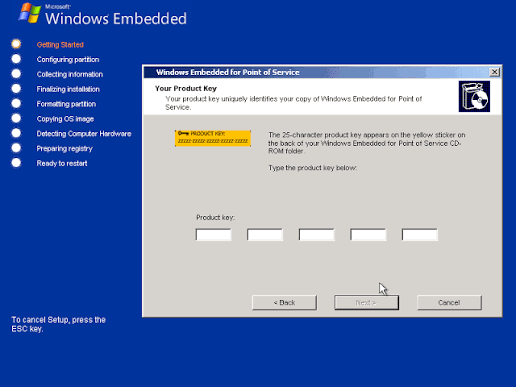
Regular Windows XP installs as one complete package. XP Embedded works differently. You don’t just “install” it. You build it. Using Microsoft’s development tools, you choose the exact parts of Windows your device needs, such as networking, a display driver, a browser or a media player, and leave everything else out. The tools then create a custom Windows image, which you deploy to the device.
That’s why the download includes development tools and a component database, not just a standard Windows setup disc.
Key Features of Windows XP Embedded SP2
1. Componentized design
Choose from over 10,000 components to build exactly the operating system you need. Leaving out what you don’t use makes the system smaller and reduces the attack surface.
2. Full Windows XP compatibility
Because it’s based on the same binaries as XP Professional, it supports the full Windows API. Standard Win32 apps and XP drivers work on it.
3. Enhanced Write Filter (EWF)
EWF protects an entire disk volume by sending all writes to RAM or a separate partition. When the device restarts, it returns to a clean state. This is perfect for kiosks and thin clients running from flash memory.
4. File Based Write Filter (FBWF)
Added with Feature Pack 2007, FBWF protects the volume while letting specific files and folders stay writable, such as settings or logs.
5. Flexible boot options
XP Embedded devices can boot from a hard disk, CompactFlash, a CD-ROM (for a fresh system every boot), a USB drive or over the network.
6. Headless support
Devices can run without a monitor, keyboard or mouse, which is ideal for servers, network appliances and control systems.
7. Small footprint
A minimal image can fit on a 32 MB CompactFlash card and run on 32 MB of RAM.
8. Windows XP SP2 security
SP2 brings Windows Firewall, better wireless support and the security fixes from Windows XP SP2 to embedded devices.
Development Tools Included (Windows Embedded Studio)
- Target Designer: Picks components and builds the custom Windows image.
- Component Designer: Creates your own components for custom drivers and applications.
- Component Database Manager: Manages the component database and repositories.
- Target Analyzer: Scans your device’s hardware and finds the drivers it needs.
Where Is Windows XP Embedded Used?
XP Embedded ran behind the scenes on millions of devices, including:
- ATMs and bank machines
- Cash registers and point-of-sale systems
- Thin clients
- Arcade and slot machines
- Industrial robots and factory controllers
- Set-top boxes and network storage (NAS)
- Time clocks, navigation devices and even railroad locomotives
Windows XP Embedded vs Windows XP Professional
| Feature | XP Embedded | XP Professional |
|---|---|---|
| Installation | Custom-built image | Standard setup |
| Components | Pick only what you need | Everything included |
| Minimum footprint | About 32 MB | 1.5 GB |
| Write filters (EWF/FBWF) | ✔ | ❌ |
| Boot from CD/USB/network | ✔ | Limited |
| Headless operation | ✔ | ❌ |
| Licensing | Embedded devices only | Desktop PCs |
Is Windows XP Embedded SP2 Still Worth Using?
For new projects, no. SP2 support ended in 2011, and all XP Embedded support ended in 2016. Modern projects should use newer Windows IoT releases.
It’s still useful for:
- Maintaining legacy devices that already run XPe
- Learning how embedded Windows images are built
- Retro computing and collectors
- Virtual machine testing of old embedded setups
Frequently Asked Questions
What is Windows XP Embedded?
It’s a componentized version of Windows XP Professional that lets device makers build a custom, lightweight Windows for dedicated devices.
Can I install XP Embedded on a normal PC?
Its license limits it to embedded devices, not general desktop PCs. Technically, it’s built with the development tools rather than installed like normal XP.
What is Feature Pack 2007?
An optional upgrade for XP Embedded SP2. It added the File Based Write Filter, USB 2.0 boot, smaller re-factored components and a rollup of security updates.
What is the latest version of XP Embedded?
Service Pack 3, released in November 2008. It was later followed by Windows Embedded Standard 2009.
Does XP Embedded still get updates?
No. Extended support for XP Embedded ended on January 12, 2016.